Nanosatellite Design Under Shannon's Condition
- theandybrock
- Oct 26, 2022
- 2 min read
Updated: Oct 28, 2022
When observing through SAR (Synthetic Aperture Radar), the resolution of image is significant to maintain. Pixels are mentioned whenever talking about resolution, we will mainly be discussing about the azimuth pixel's length(p_a) in this blog.
One easy way to define is through "Pulse Repetition Frequency" (f_a). It represents the number of pulses that's propagated per second. We also knew the velocity of the satellite, stating how far it moves in a second. By dividing them together, v/f_a, (v as modulus velocity***), we shall get how many meters are in a azimuth pixel. Perhaps, a picture might help:

Another method requires a relatively route that's more complex.

Take a look of the green lines, that is the phase difference created when the satellite moves while collecting signals reflected by target A ( they were all disseminated at the same time). Now, we adjust these phase differences by modifying them, and combine data when they are aligned. Problem is, B which is p_a (as smallest distance we were able to discern) apart from A were also illuminated reflecting signals back. This causes noises as A is the desired target. Note that the red lines are the phase difference of B, we can give regularly distributed phase values to them so that they eventually cancel out!

R_{0} as Observing Range, λ as wavelength, D as antenna length, L as illuminating distance
From the above figure, we were able to retrieve the condition of p_a's lower bound.
When the relative offset reaches one fourth of the wavelength, the phase difference cancels out:

However when in a offset that's one half of the wavelength, considering a round trip makes it a full wavelength. It's a full cycle added, nothing changes it would still be considered as target A. To cope with this problem we have to make sure this condition ( target C here for example) won't be happening, meaning target C and A needs to at least have a distance of L.
Thus giving us the equation below***:

Considering both conditions:

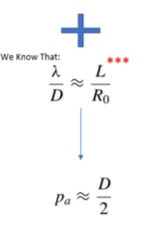
On the nanosatellite design aspect, to be able to distinguish trees, we can use the results above as a reference determining the length of antenna we should use. Also combining both form of p_a gives us the Shannon's condition, which will be used commonly afterwards.
Reference:
http://kgut.ac.ir/useruploads/1538896087482xcf.pdf


Comments